
Waste Management
Importance and Mission
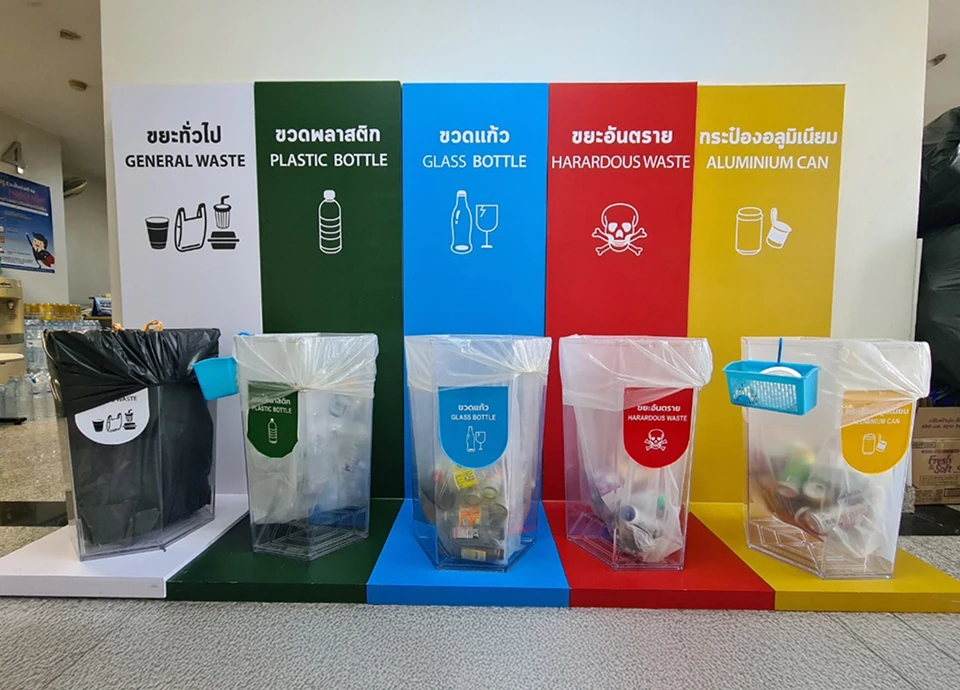
The Company places strong emphasis on waste and solid waste management throughout the business supply chain to prevent impacts on the environment and surrounding communities, establishing waste management policies aligned with relevant laws, environmental standards, and academic principles — covering segregation, transportation, and correct disposal in accordance with defined standards — while promoting waste segregation among factories within the Saha Group Industrial Parks and reuse of recoverable waste to reduce final disposal volumes. The Company applies the Waste Management Hierarchy principle — Reuse, Recovery/Reuse in Operations, and Recycle — and where waste cannot be beneficially recovered, selects the most effective and least impactful disposal process, with landfill used only as a last resort to minimize environmental impacts. These operations reflect the Company’s commitment to efficient resource management, waste reduction, and long-term sustainable development.
The Company oversees and manages factory solid waste in the common areas of the industrial parks for non-hazardous solid and industrial waste only, delegating waste management in the Saha Group Industrial Park areas to Eastern Thai Consulting 1992 Company Limited, with reference to waste management policies under the Factory Act B.E. 2535, the Public Health Act B.E. 2535, and other relevant waste management regulations. Hazardous waste generated within industrial factories is managed by each factory as the waste generator, which independently engages licensed hazardous waste disposal contractors.
Goals and Performance
Annual Target for the Year 2025
- Solid waste recycling utilization: 1%
- Solid waste disposal by Waste to Energy incineration: 1%
Impact and Performance Highlights

Solid waste recycling utilization: 2.24%
Solid waste disposal by Waste to Energy incineration: 21.01%
Supporting the SDGs

Good Health and Well-being

Industry, Innovation and Infrastructure

Responsible Consumption and Production

Climate Action

Life on Land

Partnerships for the Goals
Management Approach
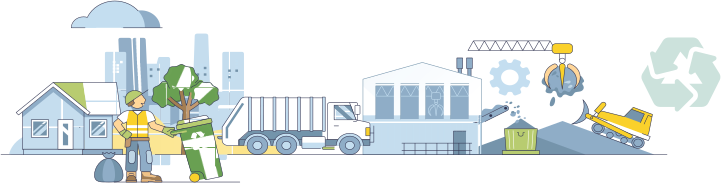
The company generated a total waste volume of 951.92 tons from operational activities, consisting of 396.42 tons of sludge and 555.50 tons of general waste. The company prioritizes waste management following the 3Rs principle and ensures proper and safe disposal through authorized agencies.
3Rs
Reduce
Reuse
Recycle
Waste Management toward Zero Waste to Landfill
The Company places strong emphasis on reducing environmental impacts from waste disposal — particularly landfilling, which generates greenhouse gases and contributes to climate change. The Company has therefore set a Zero Waste to Landfill target, aiming to minimize solid waste disposed of by landfill through the application of Circular Economy principles to maximize waste recovery prior to disposal. The Company implements joint waste segregation and management operations with operators within the Saha Group Industrial Parks, promoting factory waste segregation under the 3Rs principle. Recoverable waste is forwarded for use in energy production or other industrial activities; hazardous waste is managed by specialized, legally licensed contractors; and non-recoverable, non-recyclable waste is landfilled only as a last resort to minimize environmental impacts.
Waste Volume and Management Methods
The primary waste generated from the Company’s operations is sludge from the central wastewater treatment system within the Saha Group Industrial Parks, which the Company manages with strong emphasis on correctness in accordance with academic principles and relevant environmental requirements — applying the 3Rs (Reduce, Reuse, Recycle) principle with source segregation to improve recovery efficiency and reduce end-disposal volumes. Waste that cannot be reused or recycled is disposed of by legally and technically correct methods by officially licensed agencies or contractors, to ensure waste management does not impact the environment or surrounding communities.
In fiscal year 2025, total waste from all operations amounted to 1,194.62 tonnes, comprising 360.76 tonnes of sludge and 833.86 tonnes of general waste. The Company managed this waste through a Resource Recovery approach, implementing a Vermicompost Soil Amendment Production Project — converting wastewater treatment sludge into soil amendment material instead of disposal. The resulting soil amendment products are used in green areas within the Saha Group Industrial Parks and golf courses under the Company’s oversight — reducing external material inputs and promoting on-site circular resource utilization. This reflects the Company’s commitment to achieving Zero Waste to Landfill and supporting sustainable development through efficient waste management.
The volume of waste is processed through Reuse or Recycle.
| Details | 2024 | 2025 |
|---|---|---|
| Wastewater treatment sludge (tonnes) | 396.424 | 360.762 |
| Sludge recycled (tonnes) | 2.664 | 3.692 |
| Sludge disposed of by landfill (tonnes) | 393.760 | 357.070 |
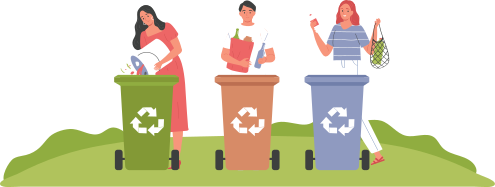
Total wastewater treatment sludge beneficially utilized in pursuit of the Zero Waste to Landfill target using the 3Rs principle from fiscal years 2022-2025 amounts to a cumulative total of 9.57 tonnes, equivalent to a reduction in greenhouse gas emissions from landfill of 7,588.71 kgCO2e.
Stakeholders Directly Impacted

Employee/ Executive
Plays a role in waste segregation and reducing waste volume within the organization

Customers
Supports products or services that minimize environmental impact

Community and Society
Experiences positive effects from environmentally friendly waste management

Government Sectors
Oversees and monitors environmental and waste management standards

Suppliers
Participates in waste reduction and the use of environmentally friendly packaging