

Water Resources Management
Importance and Mission
Water resources are a critical factor for business operations across all industries, including the Company's operations as a basic utilities service provider for customers within the Saha Group Industrial Parks. Effective water management is therefore essential to continuously meet operator water demand, reduce water scarcity risks, and strengthen service reliability.
The Company places strong emphasis on planning and managing water throughout the entire value chain — from source to discharge — to prevent and reduce potential impacts from water scarcity at both local and organizational levels, and to reduce risks from water access issues or water competition that may arise without systematic and efficient management. These operations reflect the Company's commitment to responsible water resource management under sustainable development principles, to ensure that both the Company and operators within the Saha Group Industrial Parks can conduct business continuously, with resilience to water risks and no adverse impacts on surrounding communities.
Goals and Performance
Annual Target for the Year 2025
- Treated water is reused within the area 20%
- Reduction in external water purchases for business operations 10%
- Complaints regarding water resource competition 0 Cases
Impact and Performance Highlights

Treated water that can be reused on-site: 44.21%

Reduction of external water purchases for business operations: 11.42%

Complaints regarding water resource conflicts: 0 cases
Supporting the SDGs

Clean Water and Sanitation

Responsible Consumption and Production

Life on Land

Partnerships for the Goals
Management Approach
The Company has developed an integrated water management plan to address water risks and enhance resilience and adaptability to climate change impacts, with regular monitoring of meteorological data and water volume variability to support water situation forecasting and the definition of both short-term and long-term response measures.
Water consumption reported for fiscal year 2025
| Operating Areas | Water Consumption (m3) | ||
|---|---|---|---|
| 2025 | 2024 | 2023 | |
| Bangkok Headquarters | Leased area (lump-sum service fee) | ||
| Saha Group Industrial Park Sriracha | 24,984.00 | 2,351,580.33 | 2,643,855.40 |
| Saha Group Industrial Park Kabinbur | 11,626.00 | 2,585,877.00 | 2,959,896.72 |
| Saha Group Industrial Park Lamphun | 24,529.00 | 1,984,891.00 | 2,086,699.00 |
| Saha Group Industrial Park Mae Sot | 1,488.00 | 40,356.36 | 33,970.00 |
| J Park Nihon Mura, Chonburi | 16,712.10 | 15,203.00 | 13,832.00 |
| Kabinburi Sport Club Golf Course, Prachinburi | 13,699.00 | 9,151.00 | 12,295.00 |
| Hariphunchai Sport Club Golf Course, Lamphun | 4,988.00 | 4,369.00 | 3,366.00 |
| Total | 98,026.10 | 6,991,427.69 | 7,753,914.12 |
In fiscal year 2025, the Company's total water consumption from all sources across all 8 operating areas amounted to 98,026.10 cubic meters, a decrease of 98.6 percent compared to fiscal year 2024. The primary cause of this reduction was an operational and scope-of-control restructuring: from fiscal year 2025 onwards, tap water production and management within the industrial parks has been placed under the management of Eastern Thai Consulting 1992 Company Limited, resulting in the associated water consumption being outside the Company's operational scope for the reporting period.
Water consumption reported for fiscal year 2025 therefore reflects only water use from the Company's core activities under its current operational scope. The Company continues to place strong emphasis on efficient water management and collaboration with relevant parties to support sustainable water resource utilization within its service areas.
Water Resource Risk Assessment
For long-term water risk management, the Company has incorporated scenario data from the WWF Water Risk Filter, developed by the World Wide Fund for Nature, together with the Aqueduct Water Risk Atlas, developed by the World Resources Institute (WRI), to support its analysis.
Both tools develop risk scenarios by combining the IPCC's climate change scenarios (Representative Concentration Pathways – RCP) with the Shared Socioeconomic Pathways (SSP), which are internationally recognized. Assessments are conducted for the years 2030 and 2050, based on three defined scenarios:
- Optimistic Scenario: RCP 2.6–4.5 combined with SSP1, reflecting a world that can effectively reduce greenhouse gas emissions, alongside socioeconomic development oriented toward sustainability.
- Current Trend Scenario: RCP 4.5–6.0 combined with SSP2, representing a pathway in which the world develops in line with current conditions, with moderate greenhouse gas reduction, while some regions continue to face increasing water-related risks.
- Pessimistic Scenario: RCP 6.0–8.5 combined with SSP3, reflecting a situation in which greenhouse gas emissions continue to rise while international cooperation declines, resulting in more severe water risks in terms of quantity, quality, and competition for water use.
The scenario datasets for each pathway were developed based on a 2020 baseline database, representing the current risk level of each river basin, supplemented with projected changes from future models. This allows the Company to assess impacts and prepare water-related strategies as comprehensively as possible.
The assessment results for Water Scarcity (inadequacy of water resources) and Water Stress in the area — evaluating available water volume against the ability to sufficiently meet human, ecosystem, or economic activity demands — across all 8 operational areas found that the operations in Kabin Buri (Prachinburi Province) and Lamphun Province fall into the high to very high risk level for Water Scarcity and Water Stress, as shown in detail in the table below.
| Site Name | Scenario | Water Scarcity (Water Risk Filter: WWF) | Water Stress (Aqueduct : WRI) | ||
|---|---|---|---|---|---|
| Year 2030 | Year 2050 | Year 2030 | Year 2050 | ||
| Saha Group Industrial Park Kabinburi | Optimistic |
High
|
High
|
Extremely high
|
Extremely high
|
| Current trend |
High
|
High
|
Extremely high
|
Extremely high
|
|
| Pessimistic |
High
|
High
|
Extremely high
|
Extremely high
|
|
| Saha Group Industrial Park Lamphun | Optimistic |
High
|
High
|
Extremely high
|
Extremely high
|
| Current trend |
High
|
High
|
Extremely high
|
Extremely high
|
|
| Pessimistic |
High
|
High
|
Extremely high
|
Extremely high
|
|
| Saha Group Industrial Park Mae Sot | Optimistic |
Low
|
Low
|
Low
|
Low
|
| Current trend |
Low
|
Low
|
Low
|
Low
|
|
| Pessimistic |
Low
|
Low
|
Low
|
Low
|
|
| Saha Group Industrial Park Sriracha | Optimistic |
Medium
|
Medium
|
High
|
High
|
| Current trend |
Medium
|
Medium
|
High
|
High
|
|
| Pessimistic |
High
|
High
|
High
|
High
|
|
| J-Park Sriracha Nihon Mura, Chonburi | Optimistic |
Medium
|
Medium
|
High
|
High
|
| Current trend |
Medium
|
Medium
|
High
|
High
|
|
| Pessimistic |
High
|
High
|
High
|
High
|
|
| Kabinburi Sport Club Golf Course, Prachinburi | Optimistic |
High
|
High
|
Extremely high
|
Extremely high
|
| Current trend |
High
|
High
|
Extremely high
|
Extremely high
|
|
| Pessimistic |
High
|
High
|
Extremely high
|
Extremely high
|
|
| Hariphunchai Sport Club Golf Course, Lamphun | Optimistic |
High
|
High
|
Extremely high
|
Extremely high
|
| Current trend |
High
|
High
|
Extremely high
|
Extremely high
|
|
| Pessimistic |
High
|
High
|
Extremely high
|
Extremely high
|
|
Water Resource Risk Management Measures and Approaches
To prevent risks of water resource scarcity in the Company's operations, the following prevention and impact mitigation measures have been established for managing water scarcity and water resource competition risks within the areas:
- Establish reserve water ponds or storage systems of sufficient capacity for use within the areas, capable of reserving water to meet demand within Saha Group Industrial Parks with capacities ranging from 120,000 to 1,000,000 cubic meters.
- Install high-efficiency water treatment systems to produce treated water for beneficial use within the projects.
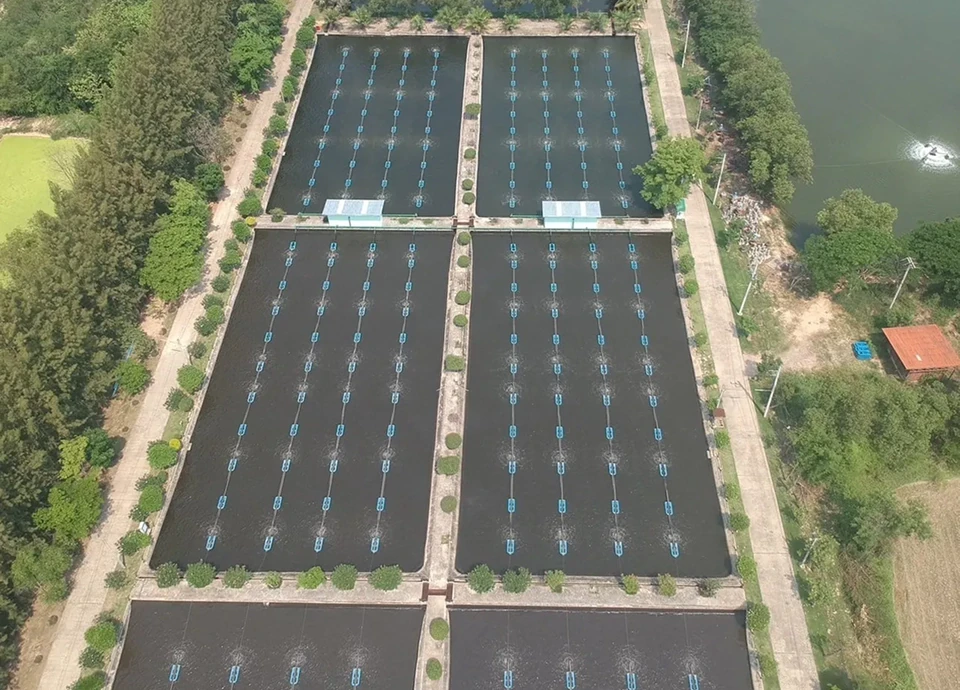
- Maximize water circulation and reuse within the areas, such as using treated water for the Company's operational activities, green areas within the projects, and golf courses.
- Enter into long-term raw water purchase agreements with raw water service providers for the projects.
- Develop technologies or projects through promotional activities to reduce water consumption or improve water resource utilization efficiency.
Water Recycling within the Saha Group Industrial Parks
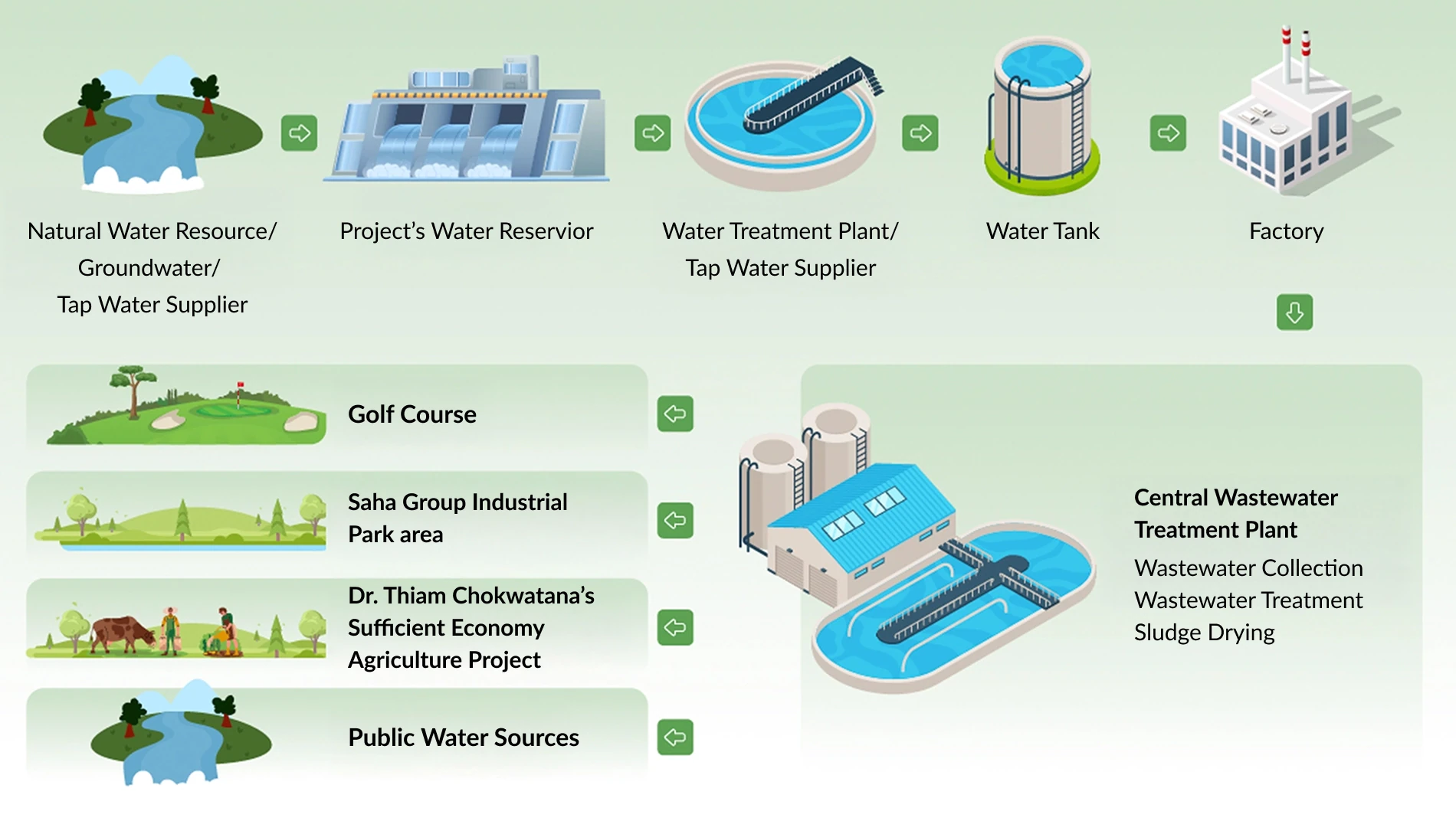
The Company operates in accordance with the criteria and indicators of the "Eco Industrial Town" framework, recognizing the importance of responsible and sustainable water resource utilization. The Company has set targets to improve water use efficiency through maximizing reuse of treated wastewater in accordance with Zero Discharge principles — to reduce dependence on raw water and reduce withdrawal from public water sources. To achieve these targets, the Company continuously controls and monitors water quality and manages water comprehensively — from the Saha Group Industrial Parks' central wastewater treatment processes through to the reuse of treated water in various areas under Company oversight, such as irrigation of green areas, cleaning, and other appropriate processes. This commitment reflects the Company's responsibility in reducing environmental impacts, promoting circular resource utilization, and supporting long-term sustainable industrial area development.
Water Recycling in Saha Group Industrial Park
Stakeholders Directly Impacted

Employee/ Executive
Comply with guidelines for water conservation and efficient water usage.

Customers
Receive high-quality and environmentally friendly utility services.

Community and Society
Benefit positively from the company’s water management practices.

Government Sectors
Monitor, regulate, and inspect standards related to water and wastewater quality.

Suppliers
Cooperate in the sustainable use of water resources.