

Supply Chain Management
Importance and Mission
The Company is committed to driving business and economic growth in Thailand while maintaining a balanced and harmonious relationship between industry and surrounding communities, grounded in good corporate governance principles and comprehensive consideration of social and environmental impacts. This is consistent with the Company's quality policy of "Good People, Good Products, Good Society" the foundational principle of its operations. Believing that sustainability must be built through supply chain collaboration, the Company places strong emphasis on promoting and developing responsible business practices among its business partners, in accordance with ESG principles and the Company's Supplier Code of Conduct, which serves as a transparent and standardized operational guideline. The Company continuously develops supplier capabilities to enhance supply chain competitiveness in terms of quality, efficiency, and risk management, leading to shared stable and sustainable business growth.
Goals and Performance
Annual Target for the Year 2025
- Proportion of Critical Tier-1 Suppliers that conduct and support the Company's core business operations, acknowledging and accepting the Supplier Code of Conduct 100%
- Proportion of Critical Tier-1 Suppliers that conduct and support the Company's core business operations, completing self-assessments on Supplier Code of Conduct compliance 100%
- Supplier payment period not exceeding 60 days

Performance

100 % Proportion of Critical Tier-1 Suppliers that conduct and support the Company's core business operations, acknowledging and accepting the Supplier Code of Conduct

100% Proportion of Critical Tier-1 Suppliers that conduct and support the Company's core business operations, completing self-assessments on Supplier Code of Conduct compliance

Average supplier payment period 67 days
Supporting the SDGs

Industry, Innovation and Infrastructure

Partnerships for the Goals
Management Approach
The Company has categorized its supply chain business partners and contractors (Tier-1 Suppliers) by screening and identifying key suppliers that directly support the Company's core business operations, are difficult to replace with alternative suppliers, and have procurement or contracting values of significant importance to business operations. In fiscal year 2025, the Tier-1 Supplier details are as follows:
| Supplier Details | Number |
|---|---|
| Business partners and contractors in the supply chain (Tier – 1 Supplier) | 96 |
| key suppliers that conduct and support the Company's core business operations (Critical Tier - 1 Supplier) | 6 |
The Company places strong emphasis on sustainable supply chain development, with an operational framework focused on the systematic selection, evaluation, and management of business partners to reduce business risks and ESG impacts, while simultaneously strengthening supplier capabilities for shared responsible growth. In fiscal year 2025, the Company conducted analysis and categorization of Significant Suppliers based on criteria covering business importance and sustainability risk levels, comprising:
- Critical Tier-1 Suppliers that conduct and support the Company's core business operations, or
- Critical Tier-1 Suppliers with critical and high potential ESG risks (Critical Tier-1 and High Potential ESG Risk Suppliers)
The Company analyzed its supplier base to identify and rank Critical Tier-1 Suppliers that transact with and support the Company's core business operations, using the Supplier Code of Conduct (SCoC) (Supplier Code of Conduct: Supplier Code of Conduct ) as the primary governance framework for supplier operations. A Self-Assessment Questionnaire (SAQ) is used to survey compliance with the Supplier Code of Conduct for self-assessment purposes, verify requirement compliance, and monitor risks across all 3 dimensions — economic, social, and environmental — as defined in the Supplier Code of Conduct. The Company also drives suppliers toward continuous sustainability standard development to elevate efficiency and transparency in the supply chain. The process comprises 8 steps as follows:
- Compile a list of current contractual suppliers.
- Analyze and prioritize suppliers with significant business importance (Significant Suppliers).
- Communicate and acknowledge the Supplier Code of Conduct.
- Suppliers conduct sustainability performance self-assessments (SCoC Online Self-Assessment) to review individual supplier risk assessment results.
- Summarize supplier rating assessment results.
- Conduct On-site ESG Audits and report results to suppliers.
- Define the Company's management approaches and plans.
- Establish and promote collaboration between the Company and suppliers.

Self-Assessment Questionnaire (SAQ) results for 6 Critical Tier-1 Suppliers — representing 100 percent — met the defined target. In fiscal year 2025, the Company distributed the Supplier Code of Conduct compliance survey to 20 suppliers, selected based on total payment value representing 90 percent of the Company's total supplier payments.
In addition to emphasizing responsible environmental, social, and governance operations, the Company upholds fair business practice principles and promotes sound financial management for both the Company and its suppliers. The Company has set a supplier payment target of no more than 60 days, requiring suppliers to submit invoices by the 5th of each month. Payments are transferred to suppliers via bank account through the Smart system, with suppliers receiving funds within the defined payment cycle. In fiscal year 2025, the average supplier payment period was 67 Days — within the defined payment target.
| Average Payment Period | 2023 | 2024 | 2025 |
|---|---|---|---|
| 62 Days | 47 Days | 67 Days |
Procurement Process and New Supplier Registration
The Company has established procurement and supplier/contractor selection regulations and procedures under the ISO 9001 Quality Management System, comprising the Procurement Regulation (QP-CO-005) and the Supplier and Contractor Selection Regulation (QP-CO-004), to ensure that procurement processes are transparent, auditable, and aligned with good corporate governance principles.
For new supplier selection, the Company conducts comprehensive preliminary qualification screening and performance reviews. For procurement with a value of 100,000 baht or more, and contracting with a value of 200,000 baht or more, at least three quotations must be compared to select the most suitable supplier or contractor based on quality, price, product warranty, after-sales service, and delivery capability criteria, prior to submission for procurement approval. The Company has established the following qualification criteria that suppliers and contractors must meet before registration:
- At least one year of relevant work experience with expertise matching the scope of work
- Registered capital of no less than 500,000 baht
- Ownership of required tools and equipment
- Commitment to quality improvement of products and services
- Operations with due regard for environmental impact and conservation of resources and energy
The Company places strong emphasis on environmental and social responsibility, and accordingly gives preference to business partners that prioritize environmental and social sustainability. Sustainability policies published by suppliers through sustainability reports or company websites are considered, covering the following topics:
| Sustainability Topic | Relevant Issues |
|---|---|
| Environmental |
|
| Social |
|
| Governance |
|
Supplier and Service Provider Evaluation
All new suppliers must complete a post-delivery performance assessment covering the quality of goods and services provided, with results recorded in the supplier/contractor profile prior to registration approval. Key evaluation criteria include:
- Quality of goods and services
- Environmental standards, such as ISO 14001 and Green Label certification
- Corporate Social Responsibility (CSR) standards
- Safety standards, such as TIS 18001 and OHSAS 8001-2020
- Product and service safety
- Delivery timeframes
- Coordination and customer service
- Delivery quantities
- Defective goods or delivery errors
- Completeness of accompanying documentation
Suppliers with more than 24 purchase orders per year or an evaluation score of 80 points or above are registered as Company suppliers, with the supplier register reviewed annually. Suppliers with no procurement or contracting activity within three years, or with an evaluation score below 80 points, will be considered for removal from the supplier/contractor register.
Promoting Supplier Collaboration
The Company places strong emphasis on developing business partners to achieve shared sustainable growth, encouraging suppliers to conduct business in accordance with the Supplier Code of Conduct, which prioritizes environmental, social, and governance (ESG) responsibilities alongside their own economic growth. In addition to evaluating supplier Code of Conduct compliance, the Company provides developmental recommendations to help suppliers improve their sustainability performance, with an ESG improvement framework as follows:
| ESG Assessment Area | Improvement Recommendations for Suppliers |
|---|---|
| Environmental Dimension | Assessment topics:
|
| Social Dimension | 1. Labor and Human Rights Promotion and Recommendations:
|
2. Safety and Occupational Health Promotion and Recommendations:
|
|
3. Community and Social Development Promotion and Recommendations:
|
|
| Governance Dimension | 1. Business Ethics Promotion and Recommendations:
|
2. Cybersecurity and Personal Data Protection Promotion and Recommendations:
|
Selecting Office Space with Holistic Sustainability and Well-Being Considerations
In 2025, the Company selected and occupied office space in a development recognized at both national and international levels for the quality of its development, design, and sustainability management. This decision supports responsible business operations with regard to social and environmental impact and long-term growth, through a selection process that prioritizes employee well-being alongside sustainable building design. The Company's office is located in KingBridge Tower, representing 12.5 percent of the Company's total operational space certified under national and international standards. Key awards and certifications are as follows:

Real Estate Development and Design Awards
The office building has been recognized by leading real estate award platforms for development quality, sustainability, and design excellence, reflecting the project's distinction in delivering an environmentally conscious, long-life office building that creates value for stakeholders:
- PropertyGuru Asia Property Awards and PropertyGuru Thailand Property Awards in the categories of Best Office Development, Best Interior Design, Best Office Architectural Design, and Best Sustainable Development
- DOT Property Southeast Asia Awards Best Iconic Urban Development
- FIABCI-Thai Prix d'Excellence Awards recognizing excellence in sustainable real estate development
- The Quality Choice Prize affirming international quality and standards Asia Property Awards และ PropertyGuru Thailand Property Awards
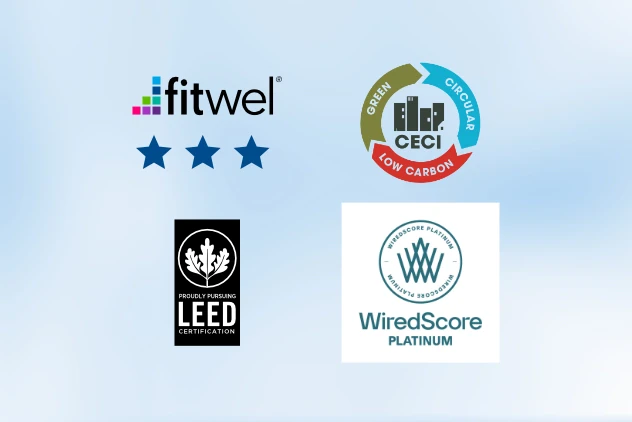
Green Building, Well-Being, and Building Technology Certifications
The office building selected by the Company holds key certifications related to sustainability management, including:
- Fitwel 3-Star Rating the first Multi-Tenant Base Building in Asia to receive the highest-level Fitwel certification, reflecting a building design that prioritizes occupant health, well-being, and quality of life
- LEED Certified (targeting LEED Gold) — demonstrating energy-efficient design, water resource management, environmentally friendly materials, and reduced environmental impact throughout the building's lifecycle
- Thailand’s First Sustainability Pilot Project (CECI – Circular Economy in Construction Industry) a pilot project applying Green, Circular, and Low Carbon principles to reduce waste and improve resource efficiency in Thailand's construction industry
- WiredScore Platinum Certification the highest-level certification for digital infrastructure, supporting operational efficiency and business continuity
Stakeholders Directly Impacted

Suppliers
Responsible for ensuring compliance with supplier standards and codes of conduct.

Employee/ Executive
- Oversee and audit procurement processes and supply chain management.
- Implement sustainable supply chain management practices.

Government Sectors
Monitor compliance with sustainability standards and legal requirements.